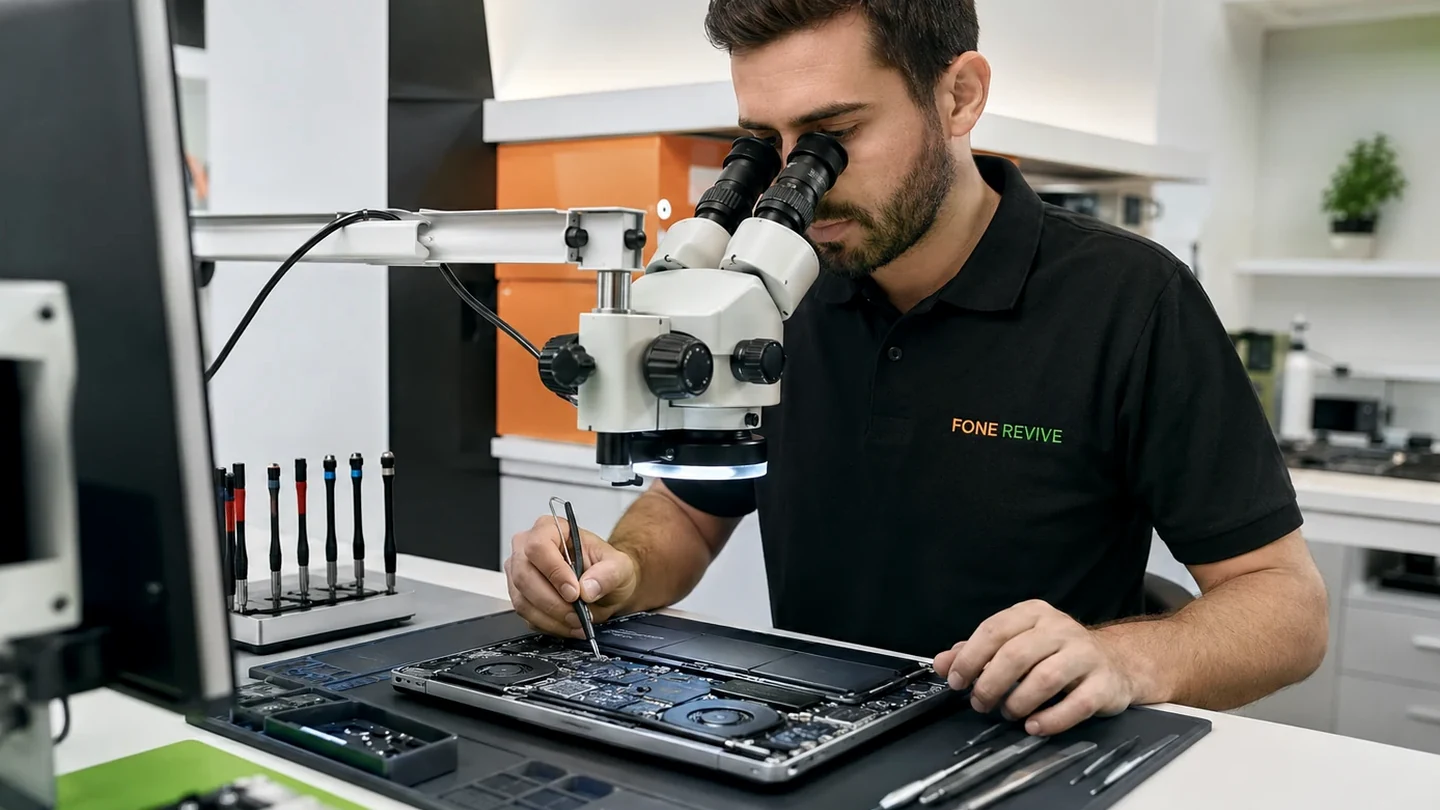
A MacBook can contain years of photos, documents, passwords, browser data and work files, so preparing it for sale deserves more care than simply deleting a few folders. The correct process depends on the Mac model and macOS version. Apple’s current UK guidance recommends backing up the Mac and resetting it to factory settings for the new owner, with Erase All Content and Settings available on compatible Apple-silicon or T2-equipped Macs running supported macOS versions.
Back up or transfer important files first
Decide what needs to move to the new computer. That may include a Time Machine backup, iCloud files, locally stored documents, photo libraries, downloads, browser profiles, email archives, creative-project files, accounting data and licence information for specialist software. Do not assume every Desktop or Documents file has successfully synced to the cloud.
Test the backup by opening a few important files from the destination or backup where practical. A sale should not become a data-recovery job because the Mac was erased before the backup was checked.
Use Apple’s supported erase process for your model
Apple says Erase All Content and Settings can be used on Mac computers with Apple silicon or the Apple T2 Security Chip when they are running macOS Monterey 12 or later. For Macs that cannot use that feature, Apple provides a separate process involving sign-out steps, macOS Recovery, Disk Utility and reinstalling macOS.
Because these steps can change over time, use the current official instructions at Apple Support: What to do before you sell, give away, trade in or recycle your Mac. Do not follow an outdated guide written for a different generation of MacBook.
Sign out and remove ownership links correctly
The new owner should not be presented with your Apple Account or an activation-related obstacle. Apple’s supported reset flow handles the relevant account and security steps for compatible Macs; older Macs may require manual sign-outs as described by Apple. If you cannot remember your account credentials, solve that before the sale rather than attempting a third-party bypass.
If the Mac belongs to a company, school or organisation, check whether it is enrolled in device management. A machine that remains managed by an organisation is not the same as an ordinary privately owned MacBook and may not be suitable for a normal resale transaction until the organisation releases it.
Check the exact MacBook model and specifications
MacBook values vary considerably between Intel, Apple silicon, screen sizes, memory and storage configurations. ‘MacBook Pro’ is not enough information for a useful valuation. Use About This Mac or System Information while the computer is still accessible to identify the model, chip/processor, memory and storage. If the machine will not boot, the serial number may help identify it, but do not post a full serial number publicly.
Tell us about battery condition, display marks, keyboard or trackpad faults, charging, ports, speakers, cameras, liquid exposure and previous repair history. Include the power adapter if you have it, but do not assume accessories guarantee a particular value.
Battery swelling and liquid damage need extra care
A swelling battery can distort the trackpad, case or keyboard area. Avoid pressing a swollen MacBook closed or continuing to charge it unnecessarily. Liquid damage can cause delayed corrosion even if the Mac currently starts. Both conditions should be disclosed during a valuation because they affect safety, repair scope and the risk to the next owner.
If valuable files are on a non-starting MacBook, make data recovery the first conversation. Selling a dead Mac for parts is irreversible if storage work or board repair is later required to recover those files.
Should you repair a MacBook before selling?
A repair can make sense when one fault is holding back an otherwise desirable MacBook. It can be poor value when the computer has several expensive faults or is old enough that the repair would use most of the resale difference. Screen assemblies, logic-board repairs and liquid-damage work can involve very different costs depending on generation.
Ask for both a MacBook selling assessment and, if appropriate, a MacBook repair assessment. Then compare the options rather than spending on a repair automatically.
Why local inspection helps
A MacBook has more variables than a simple phone grading form. Keyboard layout, battery cycle behaviour, screen condition, ports, charger, processor generation, storage and prior repairs can all matter. An in-person assessment lets you show the actual computer and ask why a fault affects the value.
We buy MacBooks locally in Bristol subject to inspection, legal ownership, account or management status, condition and current demand. We do not promise a fixed high price before seeing a device that may have hidden faults.
Frequently asked questions
Should I erase my MacBook before asking for a quote?
You can request an initial quote first. Before completing the sale, back up important files and follow Apple’s current supported erase/account-removal process.
Do you buy MacBooks that do not turn on?
Some non-starting MacBooks can still have repair or parts value. The exact model, fault, liquid history, ownership status and data requirements need assessment.
Do you buy Intel MacBooks as well as Apple-silicon models?
We assess a wide range of MacBook Air and MacBook Pro generations. Very old models may have limited market value, so send the exact model for a realistic answer.
Does a charger increase the value?
A correct working charger can make a complete package easier to resell, but it does not replace the need to assess the MacBook itself.
What if the MacBook is managed by a company or school?
It should be properly released from organisational management by the authorised organisation before an ordinary private resale. Tell us about any management profile before travelling.
Local selling help in Bristol
Visit Sell MacBook Bristol and send the exact model, chip or year where known, memory, storage and condition. We can assess working, damaged and selected non-starting MacBooks locally without inventing a guaranteed price before inspection.